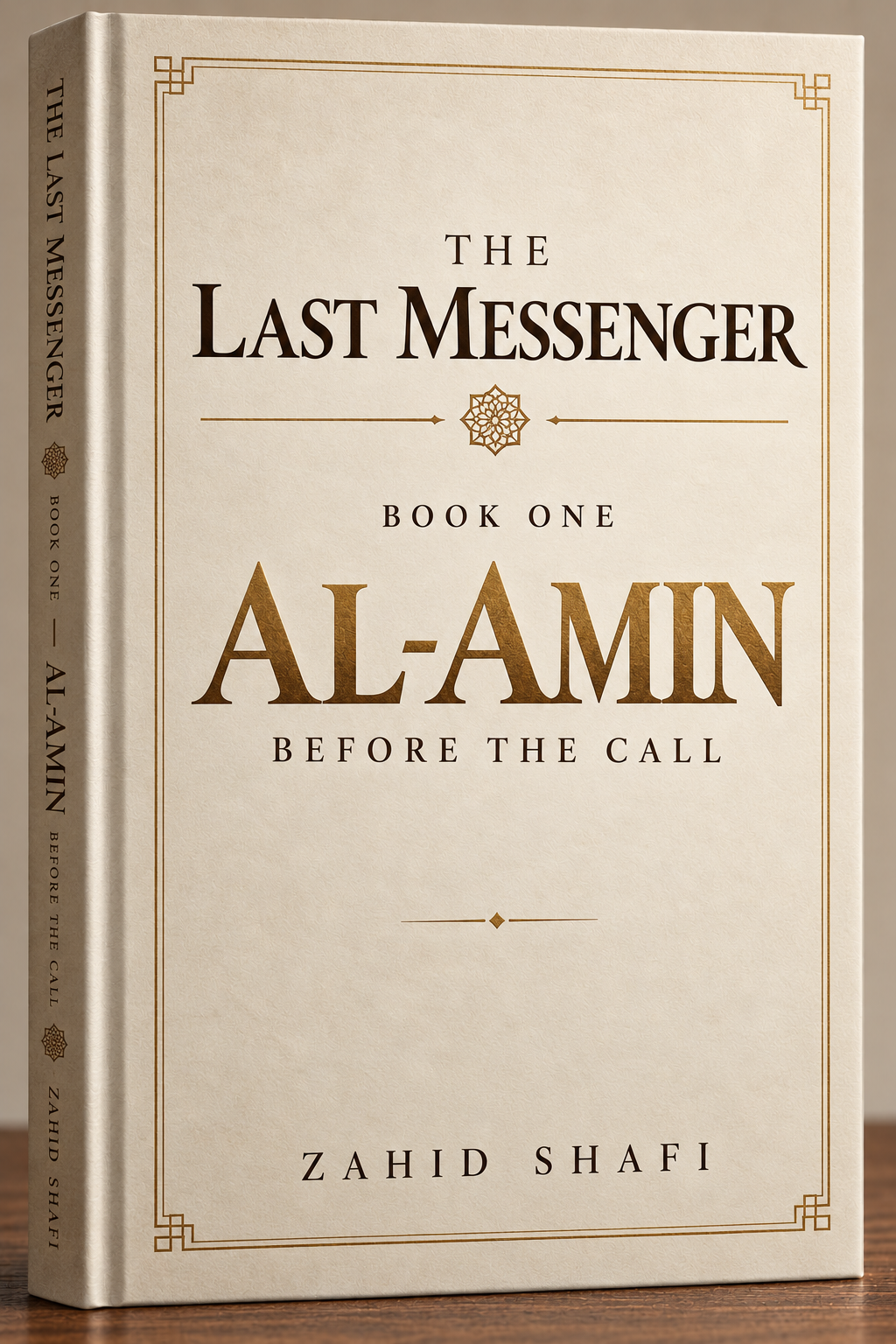
Before revelation changed the world, a boy in Makkah learned what it costs to be honest.
Set in sixth-century Arabia, the opening volume follows Muhammad ibn Abdullah from the world before his birth through orphanhood, desert fosterage, trade, marriage, and the reputation for trust that made him known as al-Amin. The narrative continues through the first revelation and the earliest private believers, ending just before the call becomes public at Safa.
Copy edit complete · Scholarly review pending
About this volume
The making of the man before the mission.
Book One is a coming-of-age story grounded in the classical seerah tradition. Its attention rests on the homes, journeys, losses, relationships, and moral choices that shaped the years before the public call.
Written for young-adult and adult readers, it uses the pace and closeness of a novel while keeping reported sacred speech and the central events accountable to their sources.
Series
The Last Messenger
Volume
Book One
Category
Narrative seerah
Audience
Young adult & adult
Historical span
Before 570–c. 613 CE
Publication date
To be announced
Formats
To be announced
ISBN & page count
Forthcoming
The journey through Book One
From the Year of the Elephant to the threshold of Safa.
The dates below are approximate. The sequence follows the narrative movement of the volume rather than presenting a complete chronology of every reported event.
01
Arabia before his birth
The story opens before the central life begins. Makkah stands at the meeting point of pilgrimage, trade, tribal memory, and inherited devotion, while the wider powers of the age press upon Arabia from beyond its deserts.
The attempted assault upon the Ka'bah in the Year of the Elephant establishes the world into which Muhammad ibn Abdullah will be born: a world certain of its customs, yet nearer to transformation than anyone within it knows.
02
The child of Abdullah and Aminah
Muhammad is born into Banu Hashim after the death of his father, Abdullah. His earliest days are held within a family of standing and affection, but they are also marked by absence.
Rather than treating childhood as a list of familiar incidents, the narrative stays close to the households and relationships that formed him before the world knew what his life would become.
03
Among Banu Sa'd
In the care of Halimah al-Sa'diyyah, the young Muhammad spends formative years away from Makkah. The desert fosterage gives the story its first great change of landscape: open country, scarcity, kinship, and the discipline of a life close to the land.
These years are presented with the restraint required by the sources while allowing readers to understand why the family remembered this child and the blessings associated with his presence.
04
From Aminah to Abu Talib
The death of his mother, Aminah, leaves Muhammad orphaned in the fullest sense. His grandfather Abd al-Muttalib takes him close, and after another loss, his uncle Abu Talib assumes his care.
The volume follows these changes not merely as dates, but as repeated separations that deepen the meaning of loyalty, protection, and belonging throughout his later life.
05
A reputation earned quietly
As Muhammad enters adulthood, Makkah comes to know him through conduct rather than proclamation. Work, travel, family responsibility, and his participation in Hilf al-Fudul reveal a young man attentive to justice in a society governed by powerful loyalties.
Long before revelation, trust gathers around his name. Al-Amin—the Trustworthy—is not treated as a title suddenly bestowed, but as the public recognition of a character formed over years.
06
Trade, recognition, and marriage
His work on behalf of Khadijah bint Khuwaylid brings two remarkable lives into closer view. Their marriage becomes the emotional centre of the volume: a home built upon confidence, dignity, affection, and mutual regard.
The years that follow allow readers to encounter family life before the burden of revelation changes its rhythm forever.
07
A dispute settled without bloodshed
When the clans of Quraysh rebuild the Ka'bah, the question of who will restore the Black Stone threatens to turn honour into violence. Muhammad's judgment gives every clan a share in the act and prevents the quarrel from becoming bloodshed.
The moment gathers the qualities the book has traced from childhood: perception, fairness, calm authority, and the trust of people who do not yet know the role he will soon be commanded to bear.
08
The first revelation
Increasingly drawn to solitude, Muhammad withdraws to Hira. There, the first command of revelation breaks into the stillness, and the private life at the centre of the book enters sacred history.
The telling remains outside the Prophet's interior point of view, grounding the scene in the transmitted reports and in what can be witnessed: the encounter, the return home, Khadijah's certainty, and the search for understanding that follows.
09
Faith begins in close circles
Before Islam is proclaimed openly, it is carried through trust: within a household, between friends, and among those who recognise truth in the character of the Messenger. Khadijah, Ali, Zayd, Abu Bakr, and the earliest believers form the first human circle around revelation.
These quiet beginnings close the volume on intimacy rather than spectacle. A world-changing call has begun, but Makkah has not yet been summoned to hear it in public.
10
Where Book One ends
The final pages approach the moment when the private call must become public. The familiar city, family bonds, and hard-won reputation established throughout the book are about to be tested by an announcement that will reorder them all.
Book One ends at that threshold. Book Two begins when the call is heard from Safa and the age of open resistance begins.
Publication updates
Follow Book One toward publication.
Receive occasional updates as Al-Amin moves through scholarly review, final preparation, and publication.